
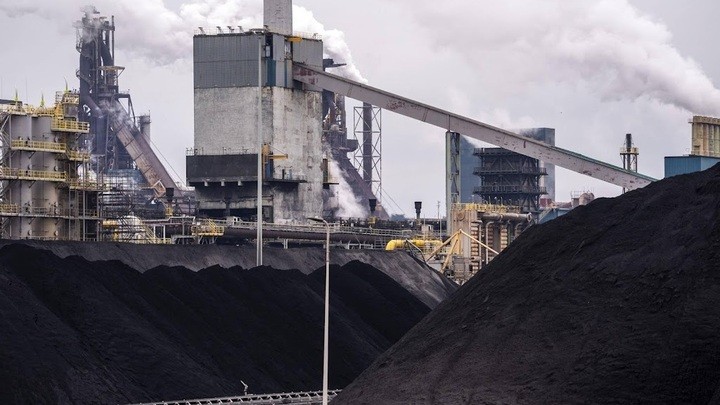
Tata Steel's operations cause structural harm to the climate and health of nearby residents. The scale of these impacts means that far-reaching measures are urgently needed to end Tata Steel’s structurally polluting business model and to deliver a sustainable solution for the future.
In September 2025, the Dutch State and Tata Steel signed a Joint Letter of Intent (JLoI), laying the groundwork for large-scale state aid aimed at greening part of the company's production and addressing health risks for residents. Advocates for the Future contends that these proposed support measures are not the solution to the major problems that Tata Steel is causing. In their current form, they are not only premature and incompatible with EU State aid frameworks, but they also fail to provide demonstrable climate and health benefits.
Our concerns
Biggest
industrial emitter in the Netherlands
Misleading
climate benefits and CO2 reductions
Risk
of fossil lock-in


The biggest industrial emitter in the Netherlands
Tata Steel emits over 11 Mton of CO2 annually, representing approximately 7-8% of national greenhouse gas emissions. In addition, Tata Steel emits particulate matter, nitrogen oxides, heavy metals, and other toxic substances that cause serious health risks to nearby residents.
Misleading climate benefits and CO2 reductions
The proposed measures do not ensure that Tata Steel becomes climate neutral. Key fossil-based installations would remain operational, meaning that a substantial part of current emissions would continue. There is no legally enforceable timetable towards full emission reduction in line with the 1.5°C target.
In addition, the claimed CO2 reductions are presented in a misleading way. A significant part of the reduction results from:
Reduced production capacity (producing less steel)
Shifting emissions from scope 1 to scope 2 and scope 3
Using a theoretical baseline that does not match Tata Steel’s actual production levels
This risks turning the climate benefit into a accounting exercise rather than real-world emissions reductions that can be attributed to the subsidised measures.
Risk of new gas-based infrastructure without enforceable guarantees for full climate neutrality
A central element of the plan is a new production route (DRP-EAF) that would initially rely heavily on natural gas. While gas may reduce direct emissions compared to coal, it remains a fossil fuel and creates serious risks of long-term dependency.
The JLoI does not contain binding obligations that guarantee a timely switch to renewable hydrogen or biomethane. Instead, it explicitly accepts the scenario in which the installation continues operating on fossil inputs for an extended period, with only financial consequences. This approach fails to prevent fossil lock-in.
"The proposed aid measures are legally inadequate. While the Dutch State grants EUR 2 billion, there is no guarantee that Tata Steel will produce green steel in the Netherlands."

Pien de Wal, Legal Associate
What do we want to achieve?

Through our written submission, we called on the Dutch State to fundamentally revise the approach to the proposed state aid package. Urgent action is necessary, but it must be lawful, transparent, enforceable, and aligned with climate and health obligations.
Goals
01
Prevent fossil lock-in and ensure climate neutrality
Public support must be conditional on binding, enforceable obligations that lead to full climate neutrality, with clear milestones, deadlines, and sanctions for non-compliance.
02
Deliver real health protection for residents
Health measures must be tied to health-based standards, independently monitored, transparently reported, and legally enforceable, ensuring that public funding results in demonstrable health gains.
03
Protect public funds and uphold the polluter pays principle
State aid must not cover costs that belong to Tata Steel's own legal responsibility, and must be strictly limited to additional, verifiable improvements.
What does the government say?
The Dutch State presents the proposed support package as necessary, effective, and compatible with EU state aid rules. It claims the measure is cost-effective, will significantly reduce emissions, and will address health risks for residents.
In reality, these claims are not sufficiently substantiated. The consultation documentation does not provide the concrete and verifiable information required to assess:
Whether the aid is necessary and proportionate
Which emissions reductions are truly caused by the subsidised measures
Whether health improvements are measurable and enforceable
Whether the plan prevents long-term fossil dependency
Without these safeguards, there is a serious risk that large amounts of public money will be spent without delivering structural climate and health benefits.
We believe that governments must act decisively to protect the public from industrial pollution and climate harm, but that action must be based on careful decision-making, enforceable guarantees, and full transparency. That is why we intervened in this public consultation.


As a non-profit organisation, we rely on your support. Your support will enable us to undertake bold and ambitious projects that shed light on the most pressing issues of our time and bring about meaningful change.